The Quarries
Waltham Quarries 1885-1958

Waltham Iron Ore Co. developed their new quarry at the terminus of the GNR Eaton Branch, which was in production by 1885. Unusually, a metre gauge quarry line was used to transport the ore to a tippler gantry over a standard gauge siding on the Eaton Branch. A weigh-bridge was sited just to the south of the gantry, and there were holding sidings to the north at the terminus.
Two Staveley designed vertical cylinder locomotives were used in the early years, very similar to the two used at Eastwell Quarries. By 1910, these had been replaced by a new 0-4-0ST locomotive called ‘Dreadnought’ (Makers: Manning Wardle & Co., Leeds, No.1757, 1910), later converted to 0-4-2ST. Four other locos were used over the years, including ‘54 Nantes’ (Makers: Veuve Corpet & L. Louvet, No.936, 1903) and ‘Cambrai’ (Makers: L. Corpet, No.493, 1888) both second-hand locos imported from France.
The ore was under relatively light overburden, and it was not until 1934 that a steam navvy arrived. Two relatively small diesel shovels were introduced during WW2 to aid production, one of which was converted to a dragline in 1944, and both worked at Waltham Quarries until closure.
The system developed in an easterly direction over the years, with the latter quarries opened at High Leys, Granby Wood, and finally Harts Quarry, adjacent to Belvoir Sawmill. The Waltham company merged with Eastwell Iron Ore Co. in 1957, before Waltham Quarries were closed in February the following year.

‘Dreadnought’ was delivered new to Waltham Quarries from the makers Manning Wardle & Co. of Leeds, (No.1757) in February 1910, to work on the new lines being developed to the south of the Belvoir Road. The locomotive was originally 0-4-0ST in configuration, but to improve stability on the quarry tracks, it was modified to 0-4-2ST with the addition of trailing wheels in 1935. ‘Dreadnought’ is seen here at Waltham Quarries in March 1953, and remained in use until closure of the quarries in 1958.

This photo shows a metre gauge tram out-of-use on the tippler in 1958. The trams used on the metre gauge quarry line at Waltham Quarries were similar to those used at Eastwell, but a slightly larger size and end profile. The bungalow seen on the Belvoir Road in the background, was constructed some while after the quarries opened, as a home for the quarry manager. Photograph by Sydney A. Leleux

Harry Christian operating a Ruston Bucyrus 21RB (No.2999, 1936) face shovel to load trams in Harts Quarry, near Belvoir Sawmill. Photo: ?/Eastwell History Group Archive
‘Dreadnought’ was delivered new to Waltham Quarries from the makers Manning Wardle & Co. of Leeds, (No.1757) in February 1910, to work on the new lines being developed to the south of the Belvoir Road. The locomotive was originally 0-4-0ST in configuration, but to improve stability on the quarry tracks, it was modified to 0-4-2ST with the addition of trailing wheels in 1935. ‘Dreadnought’ is seen here at Waltham Quarries in March 1953, and remained in use until closure of the quarries in 1958.
Eaton Quarries 1885-1965

Eaton Quarries were opened up by the Holwell Iron Company in 1885. The initial workings were in the area bounded by the Belvoir Road, the Stathern to Eaton lane, and the quarry interchange sidings on the newly completed Eaton Branch, known as Eaton Wharf. It is likely that the quarry rails were transferred from the quarry near Waltham Station, and continued to be worked by horses.
It was not until 1890, that the first steam locomotive ‘Holwell No.6’ (Makers: Hudswell Clarke & Co., Leeds, No.375, 1890) arrived new, coinciding with extension of the three foot gauge quarry railway to access new quarries north-west of the Belvoir Road. These were named Duke of Rutland’s Pit – known as Dukes Pit, and Hursts Pit, both named after the landowners.
In 1920, the Holwell Iron Co. came under control of the Stanton Ironworks Co. who assumed management of Eaton Quarries, and they became a wholly owned subsidiary of Stewarts & Lloyds in 1939.
In 1929, a bridge was constructed under the Stathern to Eaton lane to access further land on the Hurst’s lease. By 1935, quarrying had been completed in the original Dukes and Hursts pits, leaving only the area adjacent to Eaton Lodge in production. The narrow gauge railway remained in use until January 1946, when Muir Hill dumpers took over. Dennis tippers followed in 1947, followed by AEC lorries in 1956.
As quarrying progressed to the south-east adjacent to Eaton Lodge, the overburden became increasingly deep, and resulted in the introduction of a 43RB diesel dragline in 1938.

A photograph from 1929, showing workers filling wooden sided trams in Dukes Pit, Eaton. Photo: Stanton Ironworks Co./Michael Potts Collection

Dating from 1934, this photograph shows work in Hursts Quarry, now on the east side of the Stathern to Eaton lane. Eaton Lodge can just be seen in the background, but looks further away than it is, as the photographer has used a wide angle lens. Note also that side tipping trams have replaced the earlier wooden sided type. Photo: Stanton Ironworks Co./Michael Potts Collection

The Ransomes & Rapier W80 walking dragline (No.1031) seen in Hursts Quarry, to the north west of Eaton Lodge which can be seen in the background. The photo illustrates the depth of the workings as the face progressed. Photo: Lol Darby/Eastwell History Group
A photograph from 1929, showing workers filling wooden sided trams in Dukes Pit, Eaton. Photo: Stanton Ironworks Co./Michael Potts Collection

Just prior to the First World War a new quarry was opened up to the east of the Eaton Branch near Sherricliffe Farm, and in 1914 a small area next to the Eaton road bridge known as Bagshaws Quarry, which lasted until 1928.
At the beginning of 1918, Stanton Ironworks Co. Ltd. had taken control of all the Holwell quarries at Eaton. They continued to develop this area, where a standard gauge railway system was employed to connect to the Eaton Branch. This was worked initially using horses, then steam locomotives from about 1924. Beastalls Quarry, as it became known, was named after Thomas M. Beastall the landowner (from 1920). The quarry followed ironstone deposits near to the surface along several ‘fingers’ of higher ground running to the south-east. The standard gauge system at Beastalls closed in September 1957, by then under control of Stewarts and Lloyds Minerals.
Stewarts and Lloyds opened up Eaton No. 4 Quarry in 1957, which operated until October 1959, and No. 5 opened in October 1960 and ran through to December 1965.
Quarrying continued in Hursts (or Shipmans) Quarry to the east of Eaton Lodge including introduction of a Ransom & Rapier W80 walking dragline. It was delivered new and erected on site in 1941 to handle the deeper ore deposits to the east and north-east of Eaton Lodge.
Hursts South quarry was opened up in 1961, and was worked into the following year.
Production from all these later quarry areas was handled by the Dennis, and later AEC trucks. No. 5 was transferred to Staveley Minerals in June 1963, and the trucks then delivered to Stathern Ironstone Sidings at the bottom of Harby Hill, rather than Eaton Wharf as before.
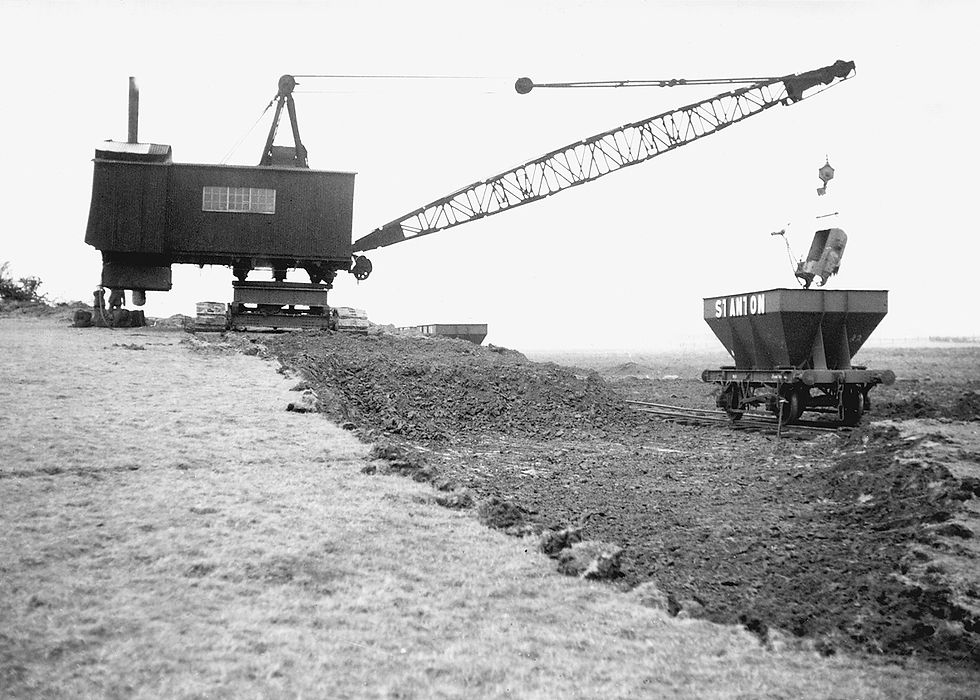
A photo from 1936, showing a Ruston and Hornsby No.60 Type steam dragline (No.795, 1923) filling hopper wagons in Beastalls Quarry. Photo: Stanton Ironworks Co. Ltd./Michael Potts Collection

The loco shed to the south of Sherricliffe Farm in Beastalls Quarry in the mid-1930s, with the connection to Eaton Branch running off to the left of the photo. The group are (l to r): Harold Peberdy, Ernest Green and Noel Yates. Photo: ?/Michael Potts Collection

No.5 Quarry in 1960, with Eaton Lodge behind the Belvoir Road in the background. The 33RB diesel dragline is seen with a 61/2 ton AEC Monarch truck. Photo: Stewarts & Lloyds Minerals/Michael Potts Collection
A photo from 1936, showing a Ruston and Hornsby No.60 Type steam dragline (No.795, 1923) filling hopper wagons in Beastalls Quarry. Photo: Stanton Ironworks Co. Ltd./Michael Potts Collection

In 1914, the Holwell Iron Co. opened up a new quarry system at Windmill Hill to the south of Eaton, remote from their main site. This area had not been developed earlier due to the problem of transporting the ore over the River Devon valley, which was finally solved by construction of a single-cable ropeway over to an interchange with the Eaton Branch line. In this arrangement the single cable was in continuous motion, the buckets were hooked onto the carrying cable which transported the loaded buckets to the interchange point, and the empties back again.
Quarrying was suspended here in 1917, as the cable system was unreliable. In about 1923, the old aerial ropeway system was replaced with a twin-cable arrangement that could handle 38 tons per hour. With this system the buckets ran along two fixed carrying cables, hauled by a lighter continuous cable. Windmill Hill Quarry resumed production, and a new face opened as Hubbards Quarry.
Grange Quarry was opened up to the east of Eaton Grange in 1941, and worked into the post-war period.
The twin-cable aerial ropeway remained in production until it broke sometime around May 1948, and the remaining three years’ production was transported by Stanton’s Dennis lorries to Eaton Wharf.

This is the only known photograph of the loading station for Eaton Ropeway Quarries on the Eaton Branch line. Two of the pylons carrying the ropeway from the quarries on the other side of the Devon Valley can just be seen in the background. No other photos have survived. Harry Diggins, an Eaton resident and keen photographer almost certainly would have taken photos, but all his photos were thrown out by his wife when he died. Photo: Stanton Ironworks Co. Ltd.

A relatively rare photograph of locomotive ‘Stanton No.9’ (Makers: Hudswell Clarke & Co., Leeds, No.506, 1898), with a rake of empty trams at Eaton Ropeway Quarries. The buildings in the background are thought to be those to the south-west of Eaton Grange, but the exact location has not been established, so any ideas are welcome! Photograph by Doug Creasey/Ian Creasey Collection
This is the only known photograph of the loading station for Eaton Ropeway Quarries on the Eaton Branch line. Two of the pylons carrying the ropeway from the quarries on the other side of the Devon Valley can just be seen in the background. No other photos have survived. Harry Diggins, an Eaton resident and keen photographer almost certainly would have taken photos, but all his photos were thrown out by his wife when he died. Photo: Stanton Ironworks Co. Ltd.
Basic Quarry 1915-1961

The Basic Quarry – pronounced Baasic Quarry – started production in 1915 adjacent to the GNR viaduct. It was run by the Staveley-backed Basic Ironstone Co. The name probably derives from the poorer quality ‘limey’ ore at this location, which only required a royalty payment of 3d a ton, as opposed to the 71/2d per ton for ore from the other Eaton Quarries. At this time Basic Quarry only required a short length of standard gauge line, worked by horses and connecting to the Eaton Branch.
Management of the quarry transferred to Parkgate Iron and Steel Co. in around 1921, for which Staveley still had a managing interest. In 1927 work began on a deep cutting to the north of the original workings near the viaduct, to access a new quarry area which was worked until the end of operations in 1961.
Standard gauge track was again used to link into the Eaton Branch, and initially an ex. War Department loco fitted with a 40hp Dorman petrol engine was used in the quarry (Makers: James & Frederick Howard, Bedford, No. 950, 1929). This was later fitted with a Ruston diesel engine by quarry fitters from Eastwell, and it left to work at Warsop Sand Quarries in 1949.
It was replaced by a Fowler 52hp diesel locomotive named ‘Douglas’ (Makers: John Fowler & Co., Leeds, No.21086, 1936).
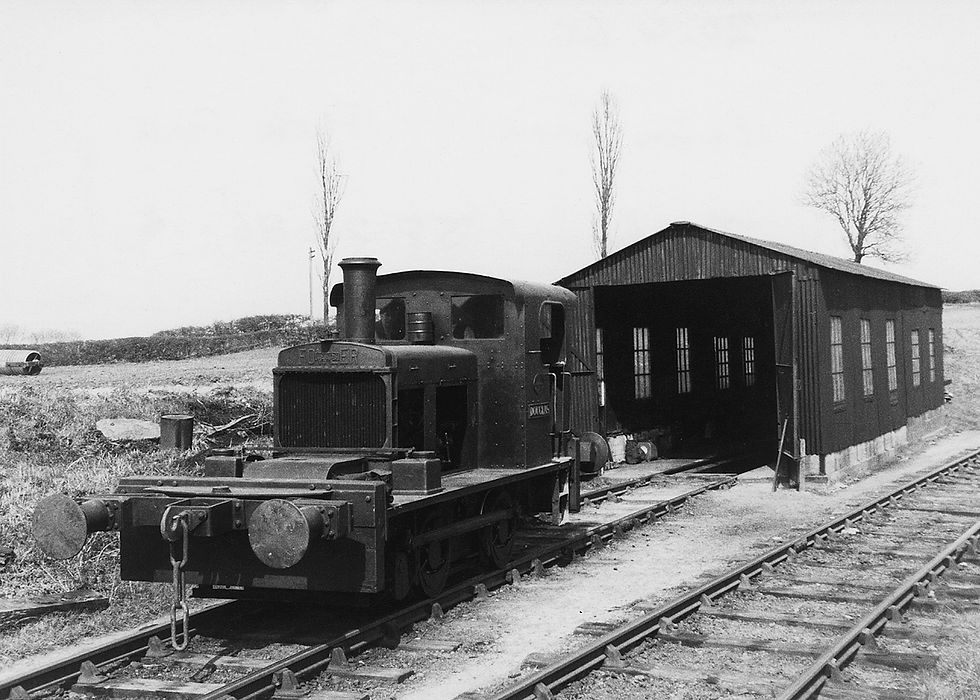
A photograph from 1960 by Sydney Leleux of ‘Douglas’ (John Fowler & Co., Leeds, No.21086, 1936) outside the engine shed in Eaton Basic Quarry. The lane from Eaton to Stathern runs behind the hedge in the background.
A photograph from 1960 by Sydney Leleux of ‘Douglas’ (John Fowler & Co., Leeds, No.21086, 1936) outside the engine shed in Eaton Basic Quarry. The lane from Eaton to Stathern runs behind the hedge in the background.
Eastwell Quarries 1881-1967

The Eastwell Iron Ore Co. had put pressure on the GNR to remove their standard gauge Eastwell Branch in 1901. After removal in stages, the Eastwell company were able to use the redundant trackbed to gradually extend their main quarry line to a new interchange siding on the Eaton Branch by about 1906. This siding was not intended for ore traffic, but did allow delivery of other supplies and machinery to this point, two miles from the incline at Eastwell.
New leases in 1911 to the Staveley, Oaks and Bestwood Iron Companies enabled Eastwell Iron Ore Co. to extend their operations into the area south of Eaton, and this section of the quarry line was called the Branston Extension. This involved construction of a bridge under the GNR Eaton Branch, a viaduct over the River Devon valley, and a bridge under Waltham Lane from Eaton.
Initial work was mainly in West Branston and Branston Quarries, and after WW2 Compressor and Branston Quarries were in production. In 1952, the line was extended under the Branston Road and Baulk Quarry was opened up, which closed when it had reached the outskirts of Branston village in 1957.

The ‘plank and barrow’ method is being employed. Firstly, top soil was removed and stored separately, then the overburden – known as ‘ratchel’ locally – was dug out and transported by wheelbarrows to the previously quarried side via the planks supported on trestles. Workers in the bottom of the quarry undercut the base of the ironstone seam, while a lookout on top looking for cracks/ signs of imminent collapse. The stone was then loaded onto wagons by hand.

Locomotive ‘Belvoir’ (Makers: Hunslet Engine Co., Leeds, No.1823, 1936) pulling a train of loaded wagons around the turn in Branston Quarry to the east of Eaton Grange. From this point it was about three miles back to the incline at Eastwell, and a series of six wheeler engines were mainly used for this work by Eastwell Quarries from 1913 onwards. ‘Belvoir’ arrived at Eastwell in 1950, from the recently closed Woolsthorpe Quarries. Photograph by B. Mettam/Industrial Railway Society Collection

A photo thought to be construction of the bridge under the Branston Road during 1951, which was undertaken by Oliver Hallam from Eastwell. This gave access for Eastwell Iron Ore Company’s narrow gauge railway into the area that became Baulk Quarry. This quarry was in production from 1952 until 1957, by which time workings had reached the outskirts of Branston village. Photo: ?/Sheila Coleman Collection
The ‘plank and barrow’ method is being employed. Firstly, top soil was removed and stored separately, then the overburden – known as ‘ratchel’ locally – was dug out and transported by wheelbarrows to the previously quarried side via the planks supported on trestles. Workers in the bottom of the quarry undercut the base of the ironstone seam, while a lookout on top looking for cracks/ signs of imminent collapse. The stone was then loaded onto wagons by hand.
Mill Hill Quarry 1957-1965

The Eastwell Company opened up Mill Hill Quarry, starting production east of the Eaton Branch in mid-1957, transferring to the west side in July 1961 to work adjacent to the existing Basic Quarry.
Use of steam locomotives on the company’s narrow gauge system was destined to end in October 1959, to be replaced by lorry working, but use of steam did not completely end. A standard gauge Peckett, (No. 1952, 1938) had been purchased second hand from the Tyne Improvement Commissioners in October 1956 by Eastwell & Waltham Iron Ore Co. Ltd. to operate in their completely separate Mill Hill Quarry. It continued in use until 1963, when it was replaced by lorry transport until closure of Mill Hill Quarry at the end of 1965.

Although the steam on the narrow gauge system was destined to end in October 1959, to be replaced by lorry working. A standard gauge Peckett, (No.1952, 1938) was purchased second hand from the Tyne Improvement Commissioners in October 1956 by Eastwell & Waltham Iron Ore Co. Ltd. to operate in their new Mill Hill Quarry at Eaton. No. 1952 is seen here standing alongside the old Basic Quarry loco shed in May 1962. This was approximately where the house called Tanfield Granary now stands

Chris Skinner in the Ruston Bucyrus shovel and ‘Banksman’ Harry Bursnall in Mill Hill Quarry c.1963/64. Among the duties of the Banksman, was to keeping the navvy tracks clear and greasing. Photograph by Denis Hubbard

By the 1950s there were concerns over the structural condition of the viaduct. This photo from 1955 shows the start of works to infill the structure with slag from Holwell Works to form an embankment. The slag was transported from Holwell on a weekly basis, and the operations took around two years to complete. The large concrete tubes were used to construct a culvert for the River Devon (pronounced Deevon) under the viaduct embankment Photo: Sheila Coleman Collection
Although the steam on the narrow gauge system was destined to end in October 1959, to be replaced by lorry working. A standard gauge Peckett, (No.1952, 1938) was purchased second hand from the Tyne Improvement Commissioners in October 1956 by Eastwell & Waltham Iron Ore Co. Ltd. to operate in their new Mill Hill Quarry at Eaton. No. 1952 is seen here standing alongside the old Basic Quarry loco shed in May 1962. This was approximately where the house called Tanfield Granary now stands